
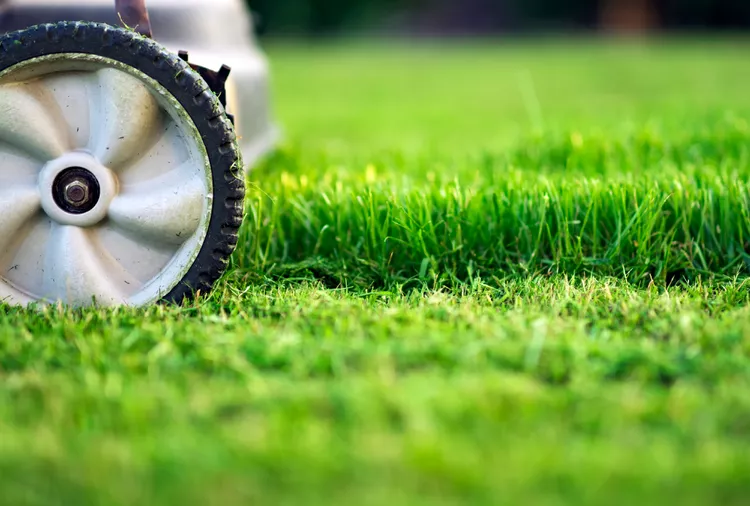
Knowing the best height to cut grass can actually help you grow a healthier lawn. The correct lawn mower height settings to use depends on a few different factors, including the type of grass and season. While it is common to cut cool-season grass, for example, at a consistent 3½ inches year-round, your lawn will thrive with less water and fertilizer if you adjust the mowing height according to conditions. Begin by getting to know your grass; each turf species has an optimal cutting height. Then, consider seasonal factors like heat and drought when adjusting the mower blades. Here’s everything you need to know to figure out the best height to cut grass.
Know Your Grass
The type of grass that makes up your lawn helps determine the best mower height settings to use. Lawn grass is divided into two groups—cool-season grasses and warm-season grasses. If you live in a region that doesn’t receive snow in the winter, your lawn is a warm-season grass, such as Bermudagrass. St. Augustinegrass, or zoysiagrass. If winter brings snow to your landscape, you’re likely growing a cool-season grass, such as Kentucky bluegrass, tall fescue, or perennial ryegrass.
Homeowners in moderate coastal climates and the lower Midwest might be growing cool-season or warm-season grass. Here's how to identify cool-season or warm-season grasses in moderate climates:
- If your turf has a soft texture and stays green late into the fall, it’s likely a cool-season grass.
- If the lawn has a coarse texture and quickly turns brown in cool weather, it’s probably warm-season grass.
Lawn Mower Height Settings for Cool-Season Grasses
Cool-season grasses are typically mowed at a cutting height of 2½ to 3½ inches. However, the best height to cut grass in a cool-season lawn fluctuates by season. These types of lawn grasses grow most vigorously when daytime highs are in the 70s and below—generally in the spring and fall. Expect them to quickly green up in spring when the days lengthen and temperatures rise. You’ll likely mow every five to seven days in spring.
The recommended mowing height varies by cool-season species. Set your mower blades to the higher end of the cutting range to promote a lawn with good heat and drought tolerance.
- Kentucky Bluegrass: 2½ to 3½ inches
- Perennial Ryegrass: 2½ to 3½ inches
- Tall Fescue: 3 to 4 inches
Raise the Mower Height Setting in Summer
Summer brings a period of slow growth or dormancy for many cool-season grasses as they conserve resources. It is not unusual for non-irrigated cool-season grasses to turn brown in summer; the roots are still alive, and the grass will green up again when moisture returns and temperatures drop. Increase the mowing height in summer by ½ inch to 1 inch. If you were cutting grass at 3 inches in spring, raise the blades to 3½ inches or 4 inches. The additional height helps shade the soil and encourages the grass to develop longer roots, which can better mine for water in a drought.
Prepare Cool-Season Grass for Winter
When cool-season grass begins actively growing again in early fall, lower the cutting height to 3 to 3 ½ inches for a uniform appearance. Plan to mow every week until the day length decreases in late October and cold temperatures set in. Cool-season grass remains green for weeks when high temperatures are in the 50s, but growth is minimal. Send the turf into winter at the 3 to 3½ inch height. Excessively long grass encourages vole and rodent activity in winter, yet grass cut too short is susceptible to cold weather damage.
When mowing, never cut off more than one-third of the height of the grass. For example, if the turf is 3 inches tall, set the mower to cut at 2 inches. Removing more than one-third of the leaf blade can shock the grass plant, resulting in thin turf and a shallow root system. If the lawn is overgrown, reduce the height by removing just one-third of the length at a time. It might take several mowings to get the grass back to its proper height.
Lawn Mower Height Settings for Warm-Season Grasses
Warm-season grasses are mowed at a significantly shorter height than cool-season grasses. The best height to cut grass of this type is between 1 and 2 inches tall. When mowed higher than recommended, warm-season grasses are prone to developing a destructive layer of thatch. Thatch is a buildup of dead stems and leaves on the soil surface. It hinders moisture from reaching roots and slows growth, leading to a weak, thin lawn.
When the grass is growing vigorously in summer, diligently maintain warm-season turf at the recommended cutting heights. It might be necessary to mow twice a week to maintain grass at an ideal height. Here’s the best height to cut warm-season grass by species:
- Bermudagrass: 1 to 1½ inches
- St. Augustinegrass: 1 to 2 inches
- Zoysiagrass: ½ to 1 inch
Raise the Cutting Height in Winter
Warm-season grasses will go into dormancy in fall. When temperatures moderate and days become shorter, adjust the lawn mower height setting to the top of the recommended cutting range. Taller grass will promote a deeper root system, which helps the grass survive winter well. In winter, warm-season grass grows minimally or not at all in some areas. There’s no need to mow warm-season grass when it is dormant except to manage weed growth.